
What is padel?
Guide · Padel
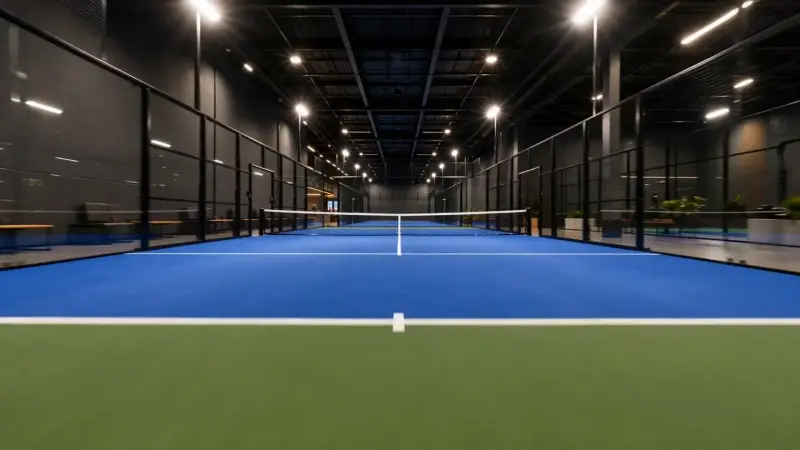
Padel is a racket sport for four players. It's played on a 20 by 10 metre court, a little smaller than a tennis court, with glass walls you can play the ball off.
You use a solid racket with no strings and a ball like a tennis ball, with a little less pressure. You serve underhand. Most beginners are rallying in their first session.
How a game works
- Two against two. You can play singles, but nearly everyone plays doubles.
- Serve underhand, at or below the waist, after one bounce, diagonally into the opposite service box.
- The ball can bounce once on your side. After that it can hit the glass and stay in play.
- Scoring is the same as tennis: 15, 30, 40, game. See how to play padel for the full rules.
The court
- 20 metres long and 10 metres wide, enclosed by walls of glass or another solid material, topped with metal mesh to 3 or 4 metres.
- The net is 88 centimetres high in the middle and 92 at the ends.
- The walls and the mesh are part of the court: after the ball bounces, it can come off them and stay in play.
- Volta will have six indoor courts, so the weather never cancels a game.
The racket and the ball
- The racket is solid, with no strings, no longer than 45.5 centimetres, and drilled with small holes. A wrist cord is required.
- The ball looks like a tennis ball but has a little less pressure, so it bounces lower and slower: about 11 psi, against 14 for a new tennis ball.
Where it came from
Padel was invented in 1969 in Acapulco, Mexico, by Enrique Corcuera, who didn't have room for a full tennis court.
It reached Spain in the early 1970s, and the International Padel Federation was founded in Madrid in 1991.
How big it is now
- The International Padel Federation counts more than 35 million amateur players and 77,300 courts worldwide, with 14,355 built in 2025 alone.
- Playtomic and PwC, counting a different way, put it at 19.4 million players and about 58,300 courts.
- In Canada it's still early: the federation's estimate is about 64 courts and 30,000 players.
Why people like it
- It's easy to start. The serve is gentle, and the walls keep rallies going.
- It's social. Four players, a small court, plenty of conversation.
- It's a real workout, without the long sprints of tennis.
What you need
A padel racket, padel balls and court shoes. No experience needed.
Starting at Volta
- Beginner clinics, when you want them.
- Pick-up games grouped by level, so you don't need a partner.
- Private and group coaching, priced separately.
Sources
- International Padel Federation: Rules of Padel (current edition) padelfip.com
- International Padel Federation: history of padel padelfip.com
- International Padel Federation: World Padel Report 2025 padelfip.com
- Playtomic and PwC: Global Padel Report playtomic.com
- LTA Padel: padel FAQs (the ball) ltapadel.org.uk
Questions
Questions we hear a lot
Is padel hard to learn?
No. Most beginners rally within a session, and beginner clinics are there when you want them.
How big is a padel court?
20 metres long by 10 metres wide, enclosed by glass or solid walls with mesh above, and a net 88 centimetres high in the middle.
Where was padel invented?
In Acapulco, Mexico, in 1969, by Enrique Corcuera.
Is padel the same as pickleball?
No. Padel has walls, a bigger court and a tennis-style ball. See "Padel vs pickleball".
Where can I play padel?
Today, the closest courts to Hamilton and Niagara are in Burlington; our padel page lists them. Volta is planning six indoor courts for the Grimsby area.
Play padel at Volta from the beginning.
Join the Founders List →
Free. No payment today.